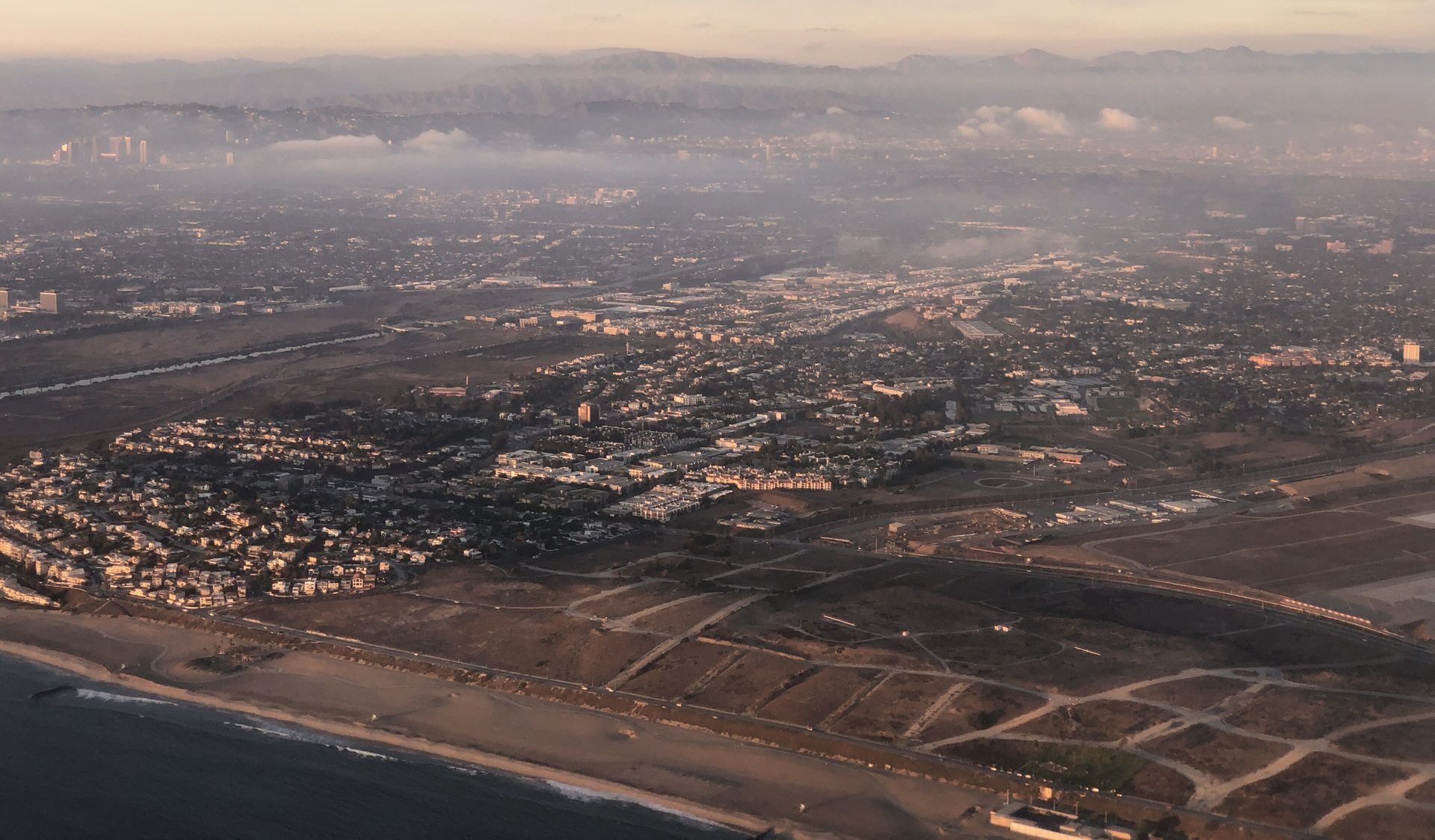
Case fileEF-021Playa del Rey, Los Angeles, 1981
Poland Sent a Spy to Los Angeles. He Recruited the Man Next Door
In February 1977 a young Polish machine-tool salesman took an apartment in a tennis complex between the beach and the Los Angeles airport, and made a friend on the court: a Hughes Aircraft radar engineer of fifty-seven who was broke. For three years the engineer photographed classified radar documents on his kitchen table with a home-movie camera and the salesman carried the film to Chicago, while the FBI watched both men around the clock and saw nothing it could take to a jury.
There is little left of my life now but I feel I am freer in prison than I was with Zacharski.
William Holden Bell, prisoner, before the Senate Permanent Subcommittee on Investigations, 4 May 1982
Playa del Rey and the Ballona shore, Los Angeles. Famartin, CC BY-SA 4.0 (source)
The film
At a glance
- Period
- 1976 to 2019
- Countries
- United States, Polish People's Republic (today Poland), Austria, Switzerland, East Germany (today Germany), Soviet Union (today Russia), Spain
- Subject
- Marian Zacharski, a Polish salesman, and William Holden Bell, a Hughes radar engineer
- Key locations
- Playa del Rey, Los Angeles, El Segundo, California, Los Angeles, Brentwood, Los Angeles, Terminal Island, Memphis, Tennessee, Springfield, Missouri, Chicago, New York, Washington, Ventura, California, Warsaw, Gdynia, Innsbruck, Linz, Geneva, Glienicke Bridge, Potsdam, Moscow, Majorca
- Themes
- Marian Zacharski, William Holden Bell, Hughes Aircraft, FBI, Polish intelligence, Glienicke Bridge, spy swap 1985, Playa del Rey
- Episode
- EF-021 · 83 min · published 25 September 2026
Case overview
This is the file: the confession in an afternoon, the tape recorder on a Sunday morning, the trial in the weeks of Solidarity and martial law, the life sentence, and the June day in 1985 when the spy walked across the Glienicke Bridge between Potsdam and West Berlin while the friend stayed in prison. Told from the FBI's own records, the engineer's testimony to the United States Senate, the Polish intelligence files read by historians at the Institute of National Remembrance, and the press of both countries.
In Los Angeles that Tuesday, William Holden Bell was sixty-five and in the fourth year of his sentence on Terminal Island. His lawyer told the Los Angeles Times: "Bell has no hard feelings towards Zacharski." A Pentagon investigative report, quoted that summer, had two words for the man Hughes had trusted for thirty years: "ripe for recruitment". American officials valued what the two of them had sent east at years of work and "hundreds of millions of dollars".
Timeline
In September 1976 the divorce came through. A week later Bell married Rita, a Belgian cabin attendant with Pan Am, twenty-four years younger, with a small boy of her own, and moved into her apartment at Cross Creek. That same year he filed for bankruptcy, owing more than fifty thousand dollars in back taxes and loans, about three hundred thousand today, and had to name his employer on the schedules. His salary was about fifty thousand dollars, a hundred and eighty thousand now, and eight hundred a month of it went in alimony and child support. His security clearance was marked secret, and nobody had reviewed it in twenty-eight years.
The overseas years, he said, were "financial nightmares". By 1974 he owed about thirty-five thousand dollars, some two hundred and forty thousand today. His marriage of nearly thirty years ended in a divorce that dragged on, with alimony to pay and four separate tax offices chasing him for back taxes on his foreign expenses. When he came home from Brussels in 1976 he found a younger crowd at Hughes and himself, in his words, "shunted off to a quiet back room". His youngest son, Kevin, the child he had been closest to, had died the year before, after an accident in Mexico.
Related documentsIn February 1977 a new tenant took an apartment on a second-floor landing in one of the buildings. Marian Zacharski was twenty-five, tall, athletic and easy to like, with a wife, Barbara, a small daughter, and an expense account. He was the new manager of the Los Angeles branch of Polamco, a Polish-owned company that sold Polish machine tools to American factories, about thirty million dollars' worth a year across thirteen states, well over a hundred million in today's money.
He had grown up in Gdynia and Sopot on the Baltic coast and then in Warsaw, the son of a wartime resistance veteran who had gone on to join the Party and run a plant for the state exporter, Metalexport. The son had joined Metalexport in 1973, at twenty-two, with a passport good for the whole world, and at the end of 1976 the firm had sent him to Chicago on a four-year posting. Three months later he had the west coast. A Warsaw weekly that profiled Polamco in May 1980 said the company's youngest branch manager was twenty-eight and coping splendidly, and quoted Polamco's director on Zacharski: "devilishly ambitious".
Related documentsIn June 1977, four months into the Los Angeles job, Zacharski flew home on leave. On the eleventh of June a lieutenant named Zdzisław Jakubczak, of the section of Department One that watched the electronics and machine industries, filed a plan to recruit him. The argument was geography: the location of the Polamco branch, he wrote, "creates potential possibilities of extending our operational activity to the west coast of the USA".
On the thirteenth he telephoned Zacharski, introduced himself as a colleague from the trade, and proposed a business meeting in a Warsaw café. At the table he dropped the pretence and asked him to work for intelligence. Zacharski refused. He said he was not cut out to be a spy, and that what he knew of spying he knew from thrillers. After an hour he agreed. The historians' words for it: he "yielded to the unspoken pressure, or, if you prefer, blackmail"; both men at the table knew that a refusal would end a promising career in the foreign trade. The lieutenant's note recorded that he had agreed "from patriotic motives". On the twenty-first of June he signed an undertaking to cooperate.
Related documentsBell and Zacharski met on the tennis court in the autumn of 1977. Bell put it to the Senate this way: "Zacharski and his wife moved into the apartment complex and he and I began to play tennis on a daily basis. He slowly became my best friend. He was about the age of my oldest son, who had been close to his mother and quite distant from me since our divorce. When you are sent to Europe, you are told to expect attempts by foreign spies, but whoever would expect it to happen here at home?"
That autumn Zacharski reported to Warsaw on a neighbour he had met on the tennis court, one of several acquaintances he listed. The file records that he met the neighbour by chance, and afterwards had to work out who the man was. On the question Bell would carry to the Senate, the study's answer is that chance proved decisive. In February 1978 Warsaw made the Bell case, codename "Pato", a priority, and upgraded Polamco's Los Angeles branch to a directorate so that its man could be given a raise.
Related documentsZacharski's own memoir dates the first money to the second of May 1978 and puts a book at the centre of it. On Bell's shelf stood the Radar Handbook, a fat industry reference, not secret, that Bell had from a company anniversary. Zacharski borrowed it, he writes, because his English was still shaky, copied every page for Warsaw, and handed it back with four hundred dollars, about two thousand today, and a sentence: "That's my small investment in improving your financial situation."
Polamco wanted customers in the aerospace industry, and Bell knew who bought what. He gave Zacharski the name of a purchasing manager at Hughes and of executives at Lockheed and Northrop, and Zacharski paid him for it, two hundred dollars here, two hundred there, and then, in Bell's words, "suddenly delivered four thousand dollars to me for my very minimal efforts". That is about twenty thousand dollars today. Zacharski talked about Polamco hiring Bell as a consultant when he retired from Hughes. Bell told the Senate: "In order to impress him, I showed him a sample of some work I had done of which I was quite proud. Although I showed it to him on the tennis court, he took it to his apartment for reading. It was classified secret."
In the middle of 1978 Zacharski picked up the telephone in his apartment, dialled the Polish commercial consul in Chicago, and said one sentence: "I suspect my daughter has pneumonia." It meant that the first batch of secret documents had been photographed.
Bell was a trusted employee. In thirty years, he told the senators, nobody had ever checked what he carried out of the plant, and it was against the rules to carry any of it out. He took the documents home. Zacharski gave him a movie camera and told him, in Bell's words, "to make a setup to photograph documents by using a single frame device": a stand, lamps, the camera pointing down at the table, one frame per page. The film was Super 8, the home-movie cartridge of the time, but not quite. The first and last few feet were ordinary colour stock, so that a customs officer holding it up to the light would see a family holiday. The thirty-four feet in the middle were high-resolution black-and-white, for print.
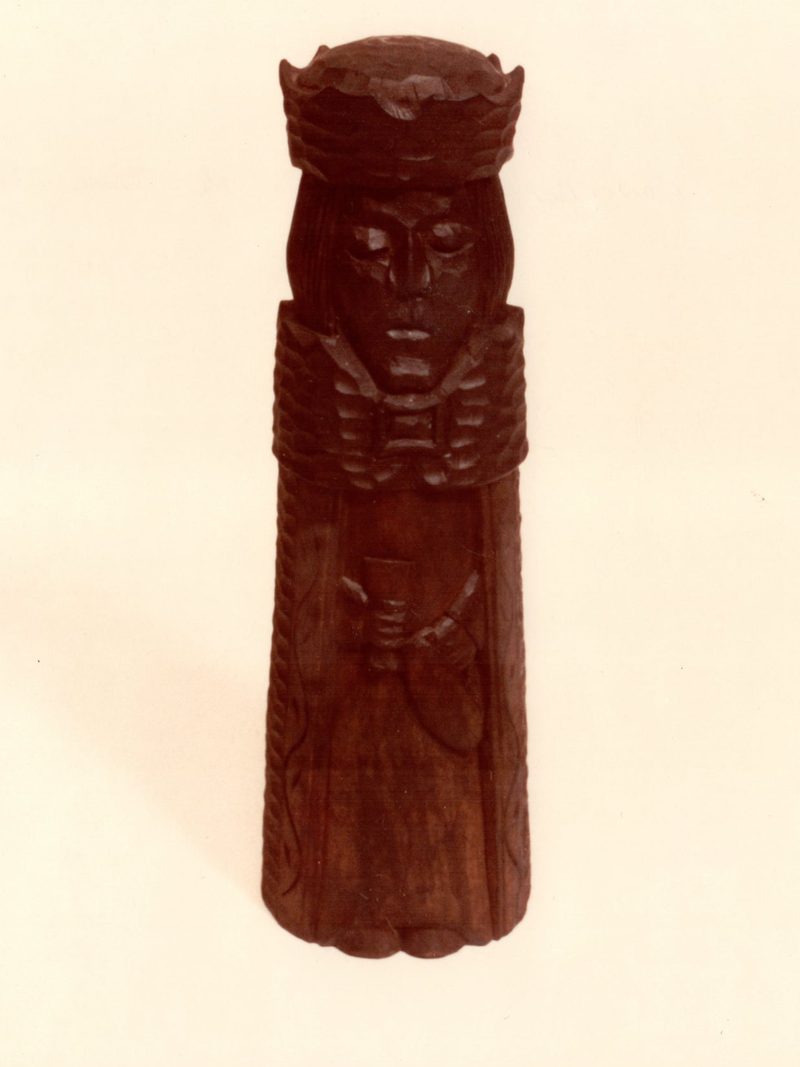
Related documentsThe wooden chess piece has a Polish name in the file. An operational instruction of the sixth of September 1978 orders that exposed films be kept in "a carved ornamental wooden figurine of a fairy-tale princess", logged as "Królewna", the Princess, a present from Lieutenant Jakubczak.
Barbara, in her debrief, watched the agents carry out "the fateful Princess". The Americans filed it as a chess piece. Warsaw's paperwork called it the Princess. It was the same object, and on the day it left the apartment it was empty.
Related documentsIn late 1978 the owners of Cross Creek announced that the apartments were being converted into condominiums, at prices over eighty thousand dollars, about four hundred thousand today. Zacharski asked Bell whether he would buy his. Zacharski's company was buying his own. He knew Bell did not have the money.
Bell told the Senate what happened next: "In view of my prospective employment by Polamco, he thought he could help me. Subsequently, he appeared at my door handing me envelopes of cash. With this money I paid the IRS and made a down payment on the condominium. I signed a receipt for the money and concealed the source from my wife." By a later count it was twelve thousand dollars, in two envelopes, in the first weeks of 1979: about sixty thousand today.
Related documentsIn February 1979, by the Bureau's own reports as the Wall Street Journal read them from the grand-jury record five years later, the CIA told the FBI that Zacharski was receiving classified documents about American weapons from an employee of Hughes Aircraft in Los Angeles. The tip had come from a CIA source who was an officer of Polish intelligence in Warsaw. Newsweek, in 1981, called him "a sensitive source". The CIA never told the FBI who he was.
What followed, in the Journal's words, was "two and a half years of virtual around-the-clock court-authorized electronic and physical surveillance". Both men's telephones were tapped. Agents in cars sat in the Cross Creek parking lot. The wiretap and surveillance logs ran to thousands of pages, and the newspaper, having read the grand-jury record, summed them up in one line: they "show no evidence that Mr. Zacharski broke any law except a traffic law once in a while when he tried to evade the FBI agents who were tailing him".
Related documentsIn a park in Innsbruck a man walked up to Bell and asked: "Are you a friend of Marian's?" The answer Bell had been given was: "Yes. I have some film in the car." The man called himself Paul. There was a second one, younger, whose name Bell never caught. The FBI's files, as a newspaper read them in 1984, named one of the two men who met Bell in Austria as Anatoliusz Inowolski, an employee of the Polish state exporter and a Polish intelligence officer since at least 1969.
Bell was given the code name Jackson and a telephone number in Poland, and he signed a receipt for the money. "There was no question of what I was getting into." The two men did not like the way he carried film. They gave him a wooden tie rack with three hidden compartments and told him to use it, or a black vinyl bag.
Related documentsThe last trip was Geneva, in the spring of 1981. In his luggage was the film of a sales brochure for the quiet radar: a Hughes design, paid for with Hughes' own money and DARPA's, "the radar that can operate without being detected by another passive receiver". Bell told the senators: "I was followed all the way."
The next day, in a lift in the United Nations building, Bell handed the quiet-radar film to his handler. "I was no longer being surveilled when I did this." Before he left, they briefed him for Mexico City. He was to carry an airline bag to a museum, and a stranger would ask: "Are you interested in the Aztec exhibit?" He was to answer: "No, I'm interested in the Mayan calendar." The stranger would show him a key chain with a black medallion and a silver P, for Poland. Bell told the Senate: "I never went. The FBI interviewed me first."
Related documentsAt ten o'clock on Tuesday the twenty-third of June 1981, three FBI agents arrived at the Hughes plant on East Imperial Highway in El Segundo. A company security officer, who had been told to expect them, sent for Bell. They talked for two hours in the plant, went for sandwiches at a deli, and then asked Bell to come with them to a room at the Holiday Inn on Century Boulevard, by the airport, where they could talk more. He agreed to that too.
Bell told the Senate how long it took: "When they contacted me, it took me a couple of hours to finally do it, but then I told everything, I provided all the evidence." He said he had thought about giving himself up before, and had been afraid to do it in Los Angeles, because the men in Europe knew where his family went to school and where they shopped. That afternoon he dictated a six-page confession. At five the agents drove him back to his office, where he handed over a red notebook with the lists of documents the Poles had asked for. At his apartment they collected more files, the camera and the film. Late in the evening, back at the Holiday Inn, he signed the confession, and the agents said they would recommend a lighter sentence. From a safe-deposit box at a Bank of America branch he handed over twenty-two gold coins, twenty-dollar pieces minted between 1897 and 1924. The FBI photographed them in rows on a grey card.
Related documentsZacharski's memoir has the next morning, Sunday the twenty-eighth, from his side. He was due to fly to Chicago that day. At about half past nine there was a knock. "Marian, we have to talk." "Bill, I'm leaving today, I've no time, I really can't." "Please, come outside with me for a moment." They walked outside the complex, and for about four minutes the machine on Bell's back ran. Bell led: hadn't he got him that secret, what was it, the secret F-15 data? Zacharski answered: "Partially, I guess so." Back in his apartment Bell spoke into the recorder: "It's now 9:30. The contact has been made and I'm returning to my apartment. I hope this damn thing works."
Zacharski was walked out in handcuffs past the cameras and driven to the maximum-security section of the federal prison on Terminal Island. Bell was formally arrested the same day, after he had returned the recorder. At eleven that night the Polish trade office in Chicago sent a telex to Warsaw. The late-night news on ABC, NBC and CBS, it said, had confirmed the arrest of citizen M. Z. and of the American citizen William Bell, shown photographs of both men, and covered the FBI's press conference in Los Angeles. The ambassador in Washington had been informed. Six months later that ambassador, Romuald Spasowski, would defect to the United States himself.
Related documentsBell pleaded guilty on Friday the ninth of October to one count: delivering a secret document to Polish agents in Switzerland. He agreed to testify. On the Tuesday, jury selection began in the court of Judge David Kenyon, a former Hollywood lawyer whom President Carter had put on the federal bench a year before.
In his closing, Brewer told the jury: "The defendant was motivated by loyalty to his country and found an American who was motivated by greed." Stadum called Bell "a Judas who was willing to betray his own country for money". The jury went out on the Thursday and came back on Monday the sixteenth of November: guilty.
Related documentsOn Monday the fourteenth, in a courtroom where a crowd of men and women were waiting to be sworn in as American citizens, Judge Kenyon sentenced Marian Zacharski. He said: "We must say to you, Mr. Zacharski, and to others who will inevitably follow, that we will not tolerate this." Life imprisonment. Bell, after eight letters from family and friends, and after the judge had called him "a man whose very nature is giving, a man who loves children", got eight years and a fine of ten thousand dollars, about thirty-seven thousand today. Stadum told the reporters outside that he hoped his client could be "traded". Zacharski did not appeal.
On Sunday the thirteenth of December 1981, General Jaruzelski declared martial law in Poland and had thousands of Solidarity people arrested overnight. The Polish ambassador in Washington, the one the Chicago telex had named, defected that month.
Related documentsEleven months later, from the federal prison camp at Springfield, Missouri, Bell told the Senate: "The FBI interviewed me first. I told them everything. There is little left of my life now but I feel I am freer in prison than I was with Zacharski."
The Bureau watched for two and a half years without an arrest because it had nothing it could take to a jury. Its assistant director told the Senate afterwards that at the time of the surveillance "we had no information that he had passed any classified information". Bell's answer to that was short: "It would have been so much easier to warn me." His clearance, he pointed out, was twenty-eight years old. "In California, you must renew your driver's license every three years."
Related documentsOn the twenty-fifth of September 1984 the Interior Ministry took Zacharski onto the staff of Department One as a career member of the service, in the rank of senior sergeant, and dated the paper the fifteenth of September 1979. He was in his cell in Memphis. He had been a serving officer of Polish intelligence, on paper, for five years.
On the twenty-ninth of May 1982 a note went into his file: his conduct since the arrest was "worthy of recognition"; he "has rejected and firmly rejects the proposals of betrayal and cooperation put to him, still maintaining an attitude worthy of a Pole and a patriot, fully deserving to be admitted to the cadre staff of Department One".
Related documentsOn the seventh of June Reagan commuted the sentence. In the Justice Department's own list of clemencies the entry reads "ZACHARSKI, Marion W.", with the first name misspelt.
The Justice Department did not want to let him go, and neither did the FBI. Caspar Weinberger at the Pentagon was against it. Helmut Schmidt, lately the West German chancellor, lobbied George Shultz at the State Department for it. The Americans asked for two Soviet dissidents, Andrei Sakharov and Anatoly Shcharansky, to be added, and Moscow said no. Time magazine put the outcome in a sentence: "When Moscow said no, the U.S. went instead for numbers."
Related documentsA Hercules took them to Berlin, and vans took them to the Glienicke Bridge over the Havel, the crossing between Potsdam and the American sector where the Soviets kept a post and a flag, so that Americans could deal with Russians there and treat East Germany as if it did not exist. Journalists had been at the railing since morning. The day was mild. At one o'clock the coach from the Potsdam side drew up to the white line and its passengers stepped across into a West German bus. From the Western end walked Zacharski; Alfred Zehe, a physicist from Dresden arrested in Boston two years earlier; Alice Michelson, an East German courier of sixty-seven; and Penyu Kostadinov, a Bulgarian trade counsellor who had been awaiting trial.
Of the six Poles, four walked. Among them, by Polish accounts, was Leszek Chróst, sentenced to death in 1980 for spying for the United States and reprieved. The fifth Pole was Jerzy Pawłowski, the sabre fencer who had won Olympic gold for Poland in 1968 and a world title three times, and who had been sentenced in 1976 to twenty-five years as an agent of the CIA. He was on the bridge that afternoon. Poland's Foreign Ministry recorded, a month later, that after persuasion by the Polish side he did not board the bus.
Related documentsFor four years Warsaw's newspapers and radio had not printed his name, not at the arrest, not at the trial, not at the sentence. At seven o'clock on the evening of the twelfth of June, Radio Warsaw read a communiqué of the state press agency: the authorities of the United States had freed "an officer of Polish intelligence of the Ministry of Internal Affairs, Captain Marian Zacharski, sentenced in the USA in 1981 to life imprisonment... The American special services repeatedly urged him to betray his homeland. The PRL intelligence officer persevered in his patriotic stance, firmly rejecting all persuasion and offers of cooperation."
It named the five Poles given up in return, with their sentences, and the fencer's refusal and his pardon. Every daily printed it the next morning. On the thirteenth Polish television showed him at Warsaw airport, and on the fourteenth the party daily printed the homecoming: the wife who had met him in Berlin, the report to his superior on the tarmac, his mother, his brother, and "two little daughters, who showered with kisses the father they had not seen for four years". Captain was a rank he had never held in Los Angeles.
Related documentsWilliam Holden Bell left federal custody on the fourth of February 1987, five years and two months into his eight-year sentence. The Bureau of Prisons still lists the two of them under consecutive numbers: 73820, not in custody as of the tenth of June 1985, the day before the bridge; 73821, not in custody as of the fourth of February 1987.
A Polish columnist in London, who watched an American television report on the case in early 1986, wrote that a reporter had found Bell in prison and asked whether it troubled him that Zacharski was free and a hero at home while he stayed behind bars. Bell said no. Zacharski had spied for his country, and he against his, and he had to atone for it. That was just.
Related documentsBell dies in Ventura, California
Bell died on the thirteenth of September 1993 in Ventura, California, an hour up the coast from the courthouse, at seventy-three. No obituary has ever been found.
On the fifteenth of August 1994 Milczanowski appointed Major Marian Zacharski head of Polish intelligence. The papers printed the service's version of his life: a career officer on a covert posting since his student days. Washington sent a démarche.
President Wałęsa demanded his resignation, and on the nineteenth, after four days in the post, he gave it, in a statement the papers printed in full: "In my whole life I have always been guided by the good of the Polish State. I was not and am not a political activist. In the name of loyalty to Poland so understood I spent four years in an American prison. I never sought any state office... I do not want to be a cause of conflicts between Poles at a moment when Poland most needs accord."
Related documentsIn June 1995, by the military prosecutor's account, Colonel Zacharski obtained from a Russian intelligence officer he had recruited a report that the sitting prime minister, Józef Oleksy, had for years been a source of Soviet and then Russian intelligence, under the cryptonym "Olin". In July he met a Russian officer named Vladimir Alganov in a hotel room on Majorca wired for sound, tried to recruit him, and failed. In December the interior minister made the accusation in parliament. Oleksy resigned in January 1996.
The prosecutor dropped the case, and in April 1996 his decision was printed at length in a Warsaw daily under a subheading that translates as "Tendentious Zacharski": the general's presentation of some facts "appears clearly tendentious", and he had "formulated conclusions and hypotheses often with no cover even in the operational materials". An internal commission found breaches of procedure. In June the papers reported that three generals were retiring, Zacharski among them. His memoir calls it resignation or dismissal, for the good of the service. He left Poland the same day, and by that November a Warsaw paper had him living mainly in Switzerland, writing a book for the American market. He stayed away seventeen years. From 2009 he published seven books, the first two of them memoirs, and he is alive.
Related documentsThe chess piece is in the FBI's collection in Washington, and in 2019 the Bureau made it its artifact of the month, under a page it titled "The Neighborhood Spy". The Princess is a line in a Warsaw file.
Related documents
Key locations
Full mapDocuments and evidence
Sources
- Archive
Transfer of United States High Technology to the Soviet Union and Soviet Bloc Nations Hearings of 4, 5, 6, 11 and 12 May 1982, Ninety-seventh Congress, second session; US Government Printing Office, Washington 1982: the testimony of William Holden Bell, printed pages 37 to 54, 4 May 1982.
Bell told a Senate committee, years later, where he had come from.
- Web
The Case of the Friendly Neighborhood Spy fbi.gov, 3 June 2019.
The chess piece is in the FBI's collection in Washington, and in 2019 the Bureau made it its artifact of the month, under a page it titled "The Neighborhood Spy".
- Web
Polish Folk Artifact Concealment Device fbi.gov, the artifact of the month, June 2019.
To open it you turned it upside down, held it for forty-five seconds and tapped it.
- Academic
Zacharski: historia prawdziwa? Wywiadowcza działalność Mariana Zacharskiego w świetle materiałów Departamentu I MSW PRL Aparat Represji w Polsce Ludowej 1944-1989, no. 19 (2021), pages 752 to 786; Institute of National Remembrance; first published as a chapter of Szpiedzy PRL-u (Kraków 2014), 2021.
At Poland's Institute of National Remembrance, the state archive of the communist years, two historians, Władysław Bułhak and Patryk Pleskot, read the declassified papers of Department One, the foreign intelligence arm of the Interior Ministry, and published what they found in 2014 and again in 2021.
- Newspaper
The Wall Street Journal: Security Loophole Page one; the copy stamped in by Zacharski's defence lawyers, archived from his website, 23 January 1984.
What followed, in the Journal's words, was "two and a half years of virtual around-the-clock court-authorized electronic and physical surveillance".
- Book
Nazywam się Zacharski. Marian Zacharski. Wbrew regułom Zysk i S-ka, Poznań; ISBN 978-83-7506-342-4, 2009.
Zacharski's own memoir dates the first money to the second of May 1978 and puts a book at the centre of it.
- Book
From Warsaw with Love: Polish Spies, the CIA, and the Forging of an Unlikely Alliance Henry Holt and Company, New York, 2021.
The officer who ran that source named him, decades later, to the historian John Pomfret: Jerzy Koryciński, a captain in Poland's foreign intelligence, a balding, unremarkable man with a poor file, who had served at the Polish consulate in Chicago in the early seventies, been recalled for keeping company with American officials, and then been put in the Warsaw section that analysed Western military technology, in the same office as the man who was running Zacharski.
- Book
Generał Kiszczak mówi... prawie wszystko Polska Oficyna Wydawnicza BGW, Warsaw; ISBN 83-7076-107-0; page 191, 1991.
In 1991 an interviewer asked General Kiszczak, the minister who had pinned on the medal, whether Zacharski had been Poland's greatest spy.
- Archive
CIA Records Search Tool (CREST): the press clippings of the case CIA reading room: clippings of the Los Angeles Times, The New York Times, The Washington Post, The Wall Street Journal, Newsweek and the New York Daily News, 1981 to 1985.
- Newspaper
Los Angeles Times Via the CIA reading room, 9 July, 22, 24 and 28 October 1981; 12 June 1985.
His lawyer told the Los Angeles Times: "Bell has no hard feelings towards Zacharski."
- Newspaper
The New York Times Via the CIA reading room, 29 June, 22 October and 17 November 1981; 12 June 1985.
The New York Times, without the name, wrote that the two who stayed "wished to remain behind out of concern for personal business and the welfare of family members".
- Newspaper
The Washington Post Via the CIA reading room, 17 November and 15 December 1981.
Bell's own total for the three years, under oath, was ninety-five thousand dollars, about three hundred and fifty thousand today.
- Newspaper
The Wall Street Journal: Convicted Spy Gave Polish Agent Details Of Stealth, B1 Bombers and F15, CIA Says Page 5; via the CIA reading room, 29 April 1982.
What went to Warsaw, by the American count, filled about twenty highly classified reports in three years.
- Newspaper
Newsweek Page 30, National Affairs; via the CIA reading room, 13 July 1981.
Newsweek, in 1981, called him "a sensitive source".
- Newspaper
New York Daily News: I turned over secrets as FBI watched: spy Page 7; via the CIA reading room, 5 May 1982.
- Newspaper
Time: An East-West Swap 24 June 1985.
Time magazine put the outcome in a sentence: "When Moscow said no, the U.S. went instead for numbers."
- Archive
Arcanum Digitheca (ADT) The Polish, London Polish and Hungarian-American press pages of the case.
Polish press pages via the Arcanum Digitheca (ADT): Polityka, 17 May 1980; Trybuna Ludu and Radio Free Europe's monitoring of the PAP communique, June 1985; Dziennik Polski (London), 1985 and 1986; Zycie Warszawy, 1986, 1994 and 1996; Prawo i Zycie, 1993; Perspektywy, 1989.
- Newspaper
Polityka Warsaw weekly, no. 20, page 18: Sztuka sprzedawania; via Arcanum, 17 May 1980.
A Warsaw weekly that profiled Polamco in May 1980 said the company's youngest branch manager was twenty-eight and coping splendidly, and quoted Polamco's director on Zacharski: "devilishly ambitious".
- Archive
Radio Free Europe monitoring of Radio Warsaw RFE/RL Polish monitoring bulletin, page 72; via Arcanum, 12 June 1985.
For four years Warsaw's newspapers and radio had not printed his name, not at the arrest, not at the trial, not at the sentence.
- Newspaper
Trybuna Ludu Warsaw, the party daily, page 2; via Arcanum, 14 June 1985.
On the thirteenth Polish television showed him at Warsaw airport, and on the fourteenth the party daily printed the homecoming: the wife who had met him in Berlin, the report to his superior on the tarmac, his mother, his brother, and "two little daughters, who showered with kisses the father they had not seen for four years".
- Newspaper
Dziennik Polski i Dziennik Żołnierza, London Front page; via Arcanum, 13 June 1985.
The Soviets and the USA exchanged spies. The USA gave up 4, the Soviets 25
- Newspaper
Tydzień Polski, London The weekly of the London Dziennik Polski, page 6; via Arcanum, 8 February 1986.
A Polish columnist in London, who watched an American television report on the case in early 1986, wrote that a reporter had found Bell in prison and asked whether it troubled him that Zacharski was free and a hero at home while he stayed behind bars.
- Newspaper
Życie Warszawy Warsaw daily; via Arcanum, 23 December 1986; 16 and 19 August and 15 September 1994; 23 April, 18 June and 30 November 1996.
A Warsaw daily visited him at the end of that year: Director Zacharski had just come back from Denmark, "the homeland of Lego", where, the paper said, eight hundred letters a week were arriving from Polish children asking for the catalogue.
- Newspaper
Perspektywy Warsaw weekly: a Pewex advertisement; via Arcanum, 1989.
By 1989 Pewex's own advertisements listed Panasonic and Sanyo video recorders and "personal computers: Atari, Commodore and IBM".
- Newspaper
Sztandar Młodych: Zarzynanie złotej kury Warsaw daily, weekend edition; via Arcanum, 31 May 1991.
In May 1991, with communism gone, Zacharski resigned under pressure from the new press, which called him, under the headline "Slaughtering the golden hen", a nomenklatura man, a communist spy in America, and "a burned man", the trade's word for an agent whose cover is gone.
- Newspaper
Prawo i Życie: Kret Warsaw weekly, no. 3, page 12; via Arcanum, January 1993.
Poland's internal inquiry of 1984 reached the same name, "though proofs are lacking", and in 1993 a Warsaw weekly quoted General Kiszczak, the old interior minister, on whether Koryciński was the man: "most probably".
- Archive
Federal Bureau of Prisons inmate locator Register numbers 73820-012 and 73821-012, Retrieved 2026.
The Bureau of Prisons still lists the two of them under consecutive numbers: 73820, not in custody as of the tenth of June 1985, the day before the bridge; 73821, not in custody as of the fourth of February 1987.
- Archive
Zacharski v. United States, No. A-266, 454 U.S. 885 Via CourtListener, 13 October 1981.
Zacharski was held, and stayed held all the way up: in October the Supreme Court of the United States would refuse him bail in a single sentence.
- Archive
Commutations granted by President Ronald Reagan, 1981 to 1989
In the Justice Department's own list of clemencies the entry reads "ZACHARSKI, Marion W.", with the first name misspelt.
- Documentary
Tausche Ostagent gegen Westagent, Teil 1: Endstation Glienicker Brücke DIALOG Filmproduktion for MDR Fernsehen; shown on phoenix, 2004.
At one o'clock the coach from the Potsdam side drew up to the white line and its passengers stepped across into a West German bus.
- Documentary
NBC Nightly News: California / Espionage Reporters John Chancellor and David Burrington, courtroom artist Liz Williams; the Vanderbilt Television News Archive's abstract, broadcast 517653, 29 June 1981.
That evening the three networks led with the story; NBC ran film, and a courtroom artist's sketches of the two men.
- Documentary
President Reagan's Address to the Nation on Christmas and Poland, December 23, 1981 Ronald Reagan Presidential Library (NARA), 23 December 1981.
On Sunday the thirteenth of December 1981, General Jaruzelski declared martial law in Poland and had thousands of Solidarity people arrested overnight.
- Documentary
President Reagan's Arrival, remarks and Departure at Bitburg Air Base in West Germany, May 5, 1985 Ronald Reagan Presidential Library (NARA), 5 May 1985.
The deal closed in May 1985, while President Reagan was in West Germany, in the same weeks that the Walker ring, a Navy spy ring that had sold codes to Moscow for years, was arrested.
- Documentary
US Navy film of the attack on Pearl Harbor, 7 December 1941 National Archives, Record Group 428, item 428-NPC-1730, 7 December 1941.
On the seventh of December 1941 the minesweeper he served on swept the channel at Pearl Harbor while the attack was on.
- Documentary
US Navy film of minesweeping at Kiska Harbor, 1943 National Archives, Record Group 428, item 428-NPC-1244, 1943.
- Documentary
United News newsreel: Marines raise flag over Iwo Jima National Archives, Record Group 208, 1945.
Off Iwo Jima an underwater explosion put him in hospital.
- Documentary
F-15 Via the National Archives and FedFlix, 1980.
Officials listed it in 1985: the radar for the B-1 bomber and for the Stealth programme; the look-down, shoot-down radar of the F-14 and F-15 fighters, which lets a pilot find a plane against the clutter of the ground beneath it; the Phoenix air-to-air missile; an all-weather radar for tanks; and an experimental radar for the Navy.
- Documentary
C-5 Galaxy: World's Largest Aircraft Department of Defense; via FedFlix, 1969.
He flew to New York, spent the night in the federal lock-up in lower Manhattan, and the next afternoon was driven to McGuire Air Force Base in New Jersey, put in chains at the wrists and ankles, and walked onto a C-5 Galaxy transport.
- Documentary
C-130 Hercules Progress Report National Archives, 1955.
A Hercules took them to Berlin, and vans took them to the Glienicke Bridge over the Havel, the crossing between Potsdam and the American sector where the Soviets kept a post and a flag, so that Americans could deal with Russians there and treat East Germany as if it did not exist.
- Documentary
TOW Missile History Via the Internet Archive, Late 1980s.
At the trial the prosecutor added a low-level radar, a covert all-weather gun system, and the TOW, the wire-guided anti-tank missile that every American armoured unit carried.
What remains unresolved
- Bell's question stands: accident, or design?
- Of the two men's accounts, the salesman's books and the engineer's testimony, which do you believe?
- Would Zacharski ever give up his secrets? Or was their existence "another piece of skilful self-advertisement"?