Case fileEF-0164 Matejki Street, Warsaw, 1971
The Colonel Who Wore Two Watches: A Murder Behind a Steel Door, Warsaw 1971
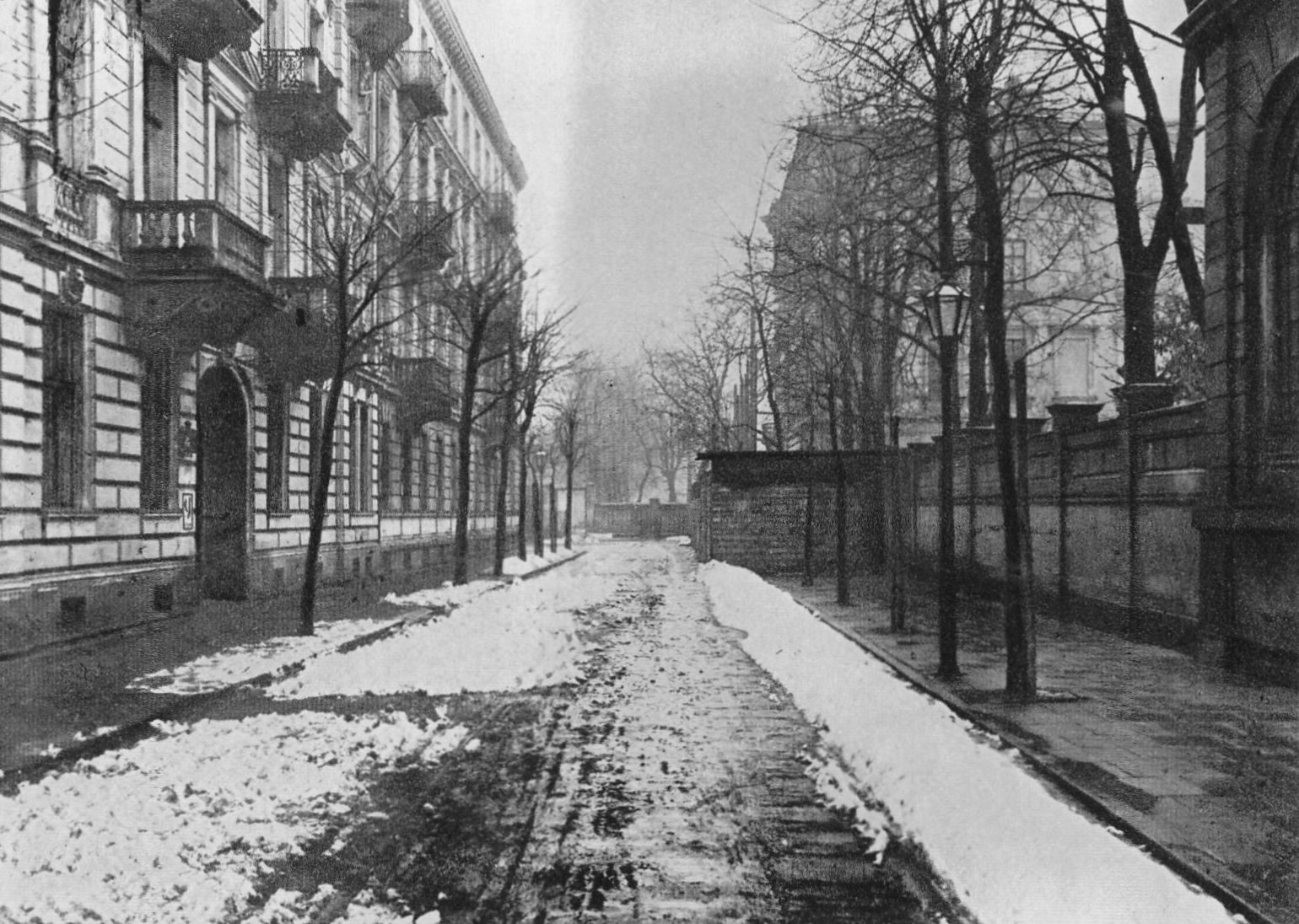
On a Friday evening in August 1971, a Warsaw militia sergeant stood at the door of flat seventeen, four Matejki Street, a few hundred steps from Poland's parliament. Nobody had answered the bell all day.
You yourself will set the date and the hour of your death.
An anonymous letter to Jan Gerhard, as colleagues at Forum remembered it
Matejki Street, before 1939. Unknown photographer, via Wikimedia Commons, Public domain (source)
The film
At a glance
- Period
- 1921 to 2010
- Countries
- Poland (today Poland and Ukraine), France, Hungary
- Subject
- Jan Gerhard, colonel, member of parliament and novelist
- Key locations
- 4 Matejki Street, Warsaw, Lwow, Montpellier, Toulouse, Bieszczady Mountains, Jablonki, Rakowiecka prison, Warsaw, Paris, Krosno, Świnoujście, Powazki military cemetery, Warsaw, Rzeszów, Baligród, Kraków, Legionowo, Budapest
- Themes
- Jan Gerhard, Warsaw 1971, People's Poland, Forum, Citizens' Militia, Radio Free Europe, cold war, Bieszczady
- Episode
- EF-016 · 59 min · published 16 October 2026
Case overview
The steel-clad door had no handle, only a knob. He pushed, and it swung open. Inside lay Jan Gerhard: colonel, member of parliament, author of a war novel every schoolchild in Poland was required to read. A decorative dagger stood in his back. On his left wrist a watch had stopped at twenty past eleven. By his right hand lay a second watch, crushed, its hands frozen at 11:13. He had been dead since morning.
In the last year of his life, Jan Gerhard published a novel he called Autopamflet, a lampoon of himself. He gave its narrator this line: most people die with their truth, and what remains is a mass of false trails leading nowhere.
Timeline
Jan Gerhard was born Wiktor Bardach in 1921, in Lwow, to a Jewish family. As a teenager he joined Betar, a uniformed Zionist youth movement, and in September 1939 he fled the invasion south through Romania and made his way to France.
He fought in a Polish division, was wounded, and was taken prisoner. A German camp doctor misread his X-rays, found tuberculosis he did not have, and shipped him back to France with the invalids. He enrolled at Montpellier to study chemistry. Then, in 1941, the Zionist youth joined the French Communist Party.
Related documentsBy 1943 he was in Toulouse under a Swiss name, Marc Verheggen, a commander in the immigrant brigades of the French resistance. By 1944 he was a major with a thousand men under him, fighting under the name Gerhard. When the war ended, the name stayed.
Related documentsOn the twenty-eighth of March 1947, on the road near Jablonki, Gerhard rode escort to General Karol Swierczewski, the man Poles called Walter, when partisans ambushed the column and shot the general dead. Swierczewski became the state's great martyr, with streets and schools and monuments to carry his name. Gerhard was blamed for the weak escort, and recalled.
In 1946 People's Poland gave Colonel Gerhard a regiment in the Bieszczady mountains, in the south-east corner of the country, to fight the UPA, the Ukrainian partisan army that held those hills for years after the war. It was a savage war, and accounts from the IPN era, the years when Poland opened its files, accuse him of ordering captured partisans shot without trial, among them a wounded man lifted off a deportee family's cart.
Related documentsIn September 1952, at the height of Stalinism, military counterintelligence arrested him as a French spy. His first interrogation ran fifty hours without a break. Under torture he confessed to organizing the assassination of General Swierczewski, the man he had watched die, and he then fought to retract the confession seven times.
He spent two years in Rakowiecka prison, was released in the thaw, and was never tried, because the case was dropped for lack of evidence. The files, opened half a century later, added a turn of their own: from 1946 to 1952 the same apparatus had carried Gerhard in its registers as an informer, codename Zan, the Polish spelling of Jean, the name he had used in France.
Related documentsHe wrote for the press agency from Paris, and in 1959 he published Flames in the Bieszczady, a novel about his mountain war. It sold half a million copies, was filmed, and went onto the required reading list of every secondary school in Poland.
From 1965 he built and ran Forum, a weekly of translated Western press that Poles called the window on the world.
The next summer the Party made him a member of parliament for Krosno, the district that holds the Bieszczady. By 1971 he had one point seven million zloty in the bank, about sixty years of an average salary, in royalties on a state-approved legend. He was fifty years old.
In 1968, when an antisemitic purge drove thousands of Polish Jews from their jobs and their country, Forum declined to print the campaign's articles, and a security-service note from that year records the editor voicing his displeasure at the removals. He survived it.
In December 1969, by the file's reconstruction, he went to Swinoujscie, a resort on the Baltic border, checked into a pension and told the manager to deny he was staying there. On New Year's Eve a man came to the desk and asked for him. Gerhard left within the hour, moved to another hotel, and cut the holiday short.
Back in Warsaw he told a colleague at the office that he had seen a ghost there: a man who was dead, or should have been. The security service later gave the episode its own codename. It was never explained.
Related documentsIn February 1970 he wrote his will. That September he returned a friend's photographs, in case, he said, something should happen to him. And from 1970, his wife would testify, he wore two wristwatches, one on each wrist. He had eighteen months left.
The man the schoolbooks printed lived like a man under siege. His flat, number seventeen, was a studio joined through the wall to number sixteen, where his wife Alicja and his daughter Malgorzata lived, with one door on the stairwell and another on the gallery. The stairwell door was clad in sheet metal and carried a French lock the experts called pick-resistant, and a wide-angle peephole he had fitted himself. Number seventeen did not appear on the tenant list downstairs. At the Forum offices he kept a Mauser pistol in an open desk drawer; at home it lay on the shelf with two full magazines; in his Peugeot the militia would later find a homemade truncheon, wired spark plugs on a cable, with only his own fingerprints on it. He received visitors, even colleagues, at the threshold. He answered no bell unannounced.
Her father approved on her word and his photographs, and set one condition, that the wedding wait until both had finished their studies. Jan Gerhard walked into a savings bank and deposited forty-three thousand zloty, about a year and a half of an average salary, into his daughter's housing book. She told her fiance the good news the same day.
Wojtasik explained the arithmetic to the interrogators without decoration: the Gerhards had money, a good car, and better society, and to get it his friend had to become the son-in-law; but he was afraid that before any wedding the father would check him, and it would come out that the daughter's beloved was pretending to be someone he was not, that the architecture was a sham. So, Wojtasik said, he decided to eliminate the man. The planning, he told them, began that same June.
Somebody re-reading the file drew a red line under them, and the bank confirmed it: on the day before his death, Jan Gerhard bought seven traveller's cheques: three thousand nine hundred zloty, about seven weeks of an average salary, in four denominations.
The cashier knew her regular customer, let him skip the required signature, and copied the seven serial numbers onto the statement she sent to the royalties agency. No cheque was found in the flat. The killers had them.
Related documentsVoices behind the door
On the evening of the nineteenth of August they came ready, and heard voices through the door: a film director was inside until half past seven, talking about turning the new book into a film, and a friend stayed until ten. She was the last visitor to see Gerhard alive. They walked away. Later that evening Garbacki telephoned: could they meet tomorrow morning, about Malgosia. Gerhard wrote three letters in his desk calendar: Z, y, g.
On Friday the twentieth of August 1971, Gerhard was alone. Alicja was at a spa in the mountains; Malgorzata was spending the summer in France. At about a quarter to nine in the morning, a neighbour one floor down heard a series of heavy blows through the ceiling, and two groans. Investigators would later stage a reconstruction to confirm how well sound carried in that stairwell. Between nine and half past, two more neighbours passed the door of seventeen and noticed, lying on the doormat, a pair of glasses and something flat, like an identity card. Nobody knocked. By the afternoon the objects were gone. In the kitchen, the glass of water with honey and lemon that he drank every morning stood full and untouched.
Just before nine Garbacki rang the bell of flat seventeen. Through the wide-angle peephole he had fitted himself, Jan Gerhard saw the face he knew from his daughter's photographs, and the man who admitted no one unannounced opened his door. The confessions preserved his first words: is that you, Zygmunt?
Related documentsAt three in the afternoon the editor did not arrive at Forum. He was famous for punctuality, and his secretary, Irena, began to telephone: the flat, then the ambulance service, then the traffic militia, asking about accidents. The office driver found the company Fiat gone from its parking spot, so perhaps he had driven somewhere. By seven in the evening the secretary was pleading with the duty officer of the Warsaw command: a member of parliament, a man who fought the UPA, missing all day. At a quarter past seven, Sergeant Wincenty Wislocki rang the bell of flat seventeen twice, put his hand on the knob, and pushed.
The same evening, state television read a communique into the main news: in his own flat in Warsaw, the well-known writer and publicist, Sejm deputy Jan Gerhard, editor-in-chief of Forum, has been murdered. The investigative organs of the interior ministry, it went on, have undertaken an energetic investigation to detect the perpetrator.
Related documentsThe autopsy on Saturday settled the medicine. The cause of death was strangulation by ligature, drawn with such force that the pathologists could barely pass a scalpel under the belt, and the head wounds alone could have killed him. One conclusion went further: this had not been done by one man. The experts from the medical academy put it in writing, and a professor from Krakow helped the militia rebuild the sequence from the blood on the walls: the first blow at the door, from behind.
The inventory the wife and daughter drew up listed what was gone: two rings, a necklace, cufflinks, and a folder of documents. Still in place were the wallet and the purse beside it, holding close to half a year of an average salary between them, three film cameras, and the pistol. The dagger in his back and the belt around his neck were his own; the household recognized both.
The Politburo discussed the murder the next morning. The timing could hardly have been worse for the new men in charge. Szlachcic wrote it flatly in his memoir: in the country and abroad, nobody doubted that the writer had been murdered for political reasons.
Radio Free Europe, the American-funded Polish-language broadcaster that the state jammed and half the country tuned to anyway, ran the killing as a political assassination, and floated a reason: Gerhard, the story went, had been about to meet Gierek himself over a scandal inside the interior ministry. The Warsaw street said the same.
Related documentsOn Wednesday the twenty-fifth of August they buried Jan Gerhard in the Avenue of the Meritorious at Powazki military cemetery. A Central Committee secretary spoke over the coffin and vowed the killers would be found. Along the paths, plainclothes militiamen photographed the mourners, face by face, and filed the pictures.
Related documentsSix days after the murder, an operative had sat down with the grieving fiance, and the record of that meeting notes that nobody asked him for an alibi; the service made contact, the document says, to secure a flow of information on what the widow and daughter thought about the killing.
Whether he was ever formally recruited was never established. The historian who found the page wrote that the plan itself had helped shield him from suspicion: the service had a use for the man, so it did not look at him.
On the thirteenth of September, Szlachcic signed order 0127 of 1971 and created an operational-investigative group under Colonel Deren, with two deputy colonels, thirty officers drawn from across the ministry, several hundred field men, daily cipher traffic, a dedicated card index, and supervision from the Central Committee. He gave it a codename: Bieszczady. The name of the mountains, which is to say, the name of the theory.
In his desk calendar, under the nineteenth of August, sat an entry nobody could crack, three letters: Z, y, g. It was checked against one thousand nine hundred names and stayed unexplained. The ministry's own tally that winter came to nine thousand operational conversations and one thousand eight hundred and fifty witnesses. And nothing.
Related documentsIn March 1972, at the ministry's training centre in Legionowo, cadets held over from election duty were marched into a hall with long tables. Off the trucks came fifty-nine sacks holding roughly two million cashed cheques, and on the boards at the front stood seven serial numbers.
On the first day of sorting, by one account already in the second sack, a number came up. By the end of that first day they had five of the seven. All five had been cashed in Hungary, in Budapest, most accounts say, in September and October 1971, and the two missing hundred-zloty cheques never surfaced at all.
It was the fifth of April 1972. By ten that evening, the militia had arrested the friend. He denied everything. Asked who Roman might be, he answered, the record says, with a full name and an exact address, down to the flat number. Then he went back to denying. The man in handcuffs was Zygmunt Garbacki, twenty-seven years old. For two years he had been at Malgorzata Gerhard's side, and for the last year, her fiance.
Facing a murder charge, he talked. The cheques and the ring came from one of those two friends, who had asked him to sell the paper quietly. And one autumn evening over vodka, that friend had told him what he had done: how he and a man he called Roman had killed the writer Gerhard.
Related documentsOn the ninth of April 1972 the ministry announced that the murderers of Jan Gerhard had been identified.
Wojtasik, brought from his cell and told that Zygmunt was already giving statements, asked the captain, in words the file kept, where Zygmunt was hurrying to, since a suspect has the right to refuse. Then he sat down and dictated his own confession, hour by hour, and corrected his friend's inventions as they came.
Related documentsOn the twenty-fifth of May 1972, in room 252 of the Warsaw provincial court, the trial opened to crowds the militia could barely manage. Entry was by ticket. Sixty-eight editorial offices were accredited, foreign ones among them, the case file ran to eighteen volumes, the murder weapons lay on the exhibit table, and reports went daily to the Party leadership.
On day one he admitted the acts and disowned his own confession: the motives I gave in the investigation, he told the court, are not true, there were others, and he asked for closed doors to name them. Behind the closed doors, by the file's account, he raised no political secrets at all.
Related documentsOn the sixteenth of June 1972 the court sentenced both to death, with loss of public rights forever, for a murder committed, the verdict said, with premeditation and exclusively for robbery, and found no mitigating circumstances for either man. The agency dispatch noted that both accepted the verdict calmly.
To the Supreme Court, Garbacki wrote that it had been affect, the affect of human nature. The court upheld the sentences on the twenty-seventh of September, and the Council of State declined clemency.
Related documentsThe papers of the twentieth of January 1973 carried a short communique: the sentences on the murderers of Jan Gerhard had been carried out. The state's own text gave their birth dates, listed their side crimes, and priced everything they had taken from the flat at about nine thousand zloty, under four months of an average salary.
Where they were hanged was not published, then or since; the court files, wrote the reporter who read them, say nothing about the last days.
Related documentsThe supervising prosecutor's own later article on the case left the political chapters out entirely; the security-service general who wrote the case's official book in 1987 left out the 1952 arrest; and in 2010 that supervising prosecutor, Jozef Gurgul, put it on the record in an interview: the leadership had pressed from the first day for political motives, French scores and Ukrainian revenge, and in an ordinary robbery nobody had believed.
The machine had authored a conspiracy, hunted it, been humiliated by a cheque, and buried the whole embarrassment under the word banditry.
Related documents
Key locations
Full mapDocuments and evidence
Sources
- Book
Zabójstwo z premedytacją Książka i Wiedza, 1987.
The case's official book of 1987, by a security-service general; the case photographs and court records on this page are film frames that show its pages.
- Book
Miasto śmierci IPN, 2015.
Patryk Pleskot, the historian who has read the whole file, keeps the case to this day in a chapter titled Question Marks, and his verdict on the investigation reads: scale, embarrassment, and political calculation, but no conspiracy.
- Academic
Grupa Operacyjno-Śledcza „Bieszczady” (1971-1972). Rozmach, kompromitacja, spisek? IPN, via Academia.edu, 2017.
Alongside hunting the killer, the group's work served to watch the circles around the dead man, and to quiet any political thread that might cast suspicion on the security apparatus itself.
- Newspaper
Kryptonim Bieszczady Polityka 34/2007, 2007.
Grzegorz Motyka, who read the same files, wrote that it is hard to imagine innocent men confessing so readily, and never taking back a word of it, even facing death.
- Book
Pitawal PRL-u 2006.
Stanislaw Podemski, the era's best-known court journalist, recorded what Warsaw said over its shoulder: that Gerhard had been on his way to Gierek with the passport-bribery affair; that the trial was theatre; and, after January 1973, that the two hanged men were alive somewhere in Bulgaria under new names.
- Book
Dzienniki
Stefan Kisielewski, the composer and columnist who kept the era's sharpest private diary, wrote his entry on the very day the ministry named the killers: the devil knows what is true here; the only fact is that at the summits of power things happen of which society knows nothing, as in tsarist Russia.
- Book
Dzienniki polityczne
Rakowski, editing Polityka then, wrote in diaries kept for posterity that the motive was improbably banal, that two brutes simply decided to butcher a man, and that the dead man's private life had astonished even his closest friends.
- Book
Memoir
Szlachcic wrote it flatly in his memoir: in the country and abroad, nobody doubted that the writer had been murdered for political reasons.
- Book
Pół prawdy
The court reporter who sat through room 252, Wanda Falkowska, turned the case four years later into a novel called Half the Truth, about a man who pretends to his whole world to be a student and a fiance.
- Book
Autopamflet 1971.
He gave its narrator this line: most people die with their truth, and what remains is a mass of false trails leading nowhere.
- Archive
Polish monitoring bulletins Blinken OSA Archivum, via Arcanum.
Radio Free Europe's transcripts of Polish state radio: the murder communique of 20 August 1971 and the report of the executions, 19 January 1973.
- Newspaper
Życie Warszawy via Arcanum, 21 August 1971.
No. 200, front page: the murder communique.
- Newspaper
Życie Warszawy via Arcanum, 22 August 1971.
No. 201: the obituaries and a profile.
- Newspaper
Życie Warszawy via Arcanum, 26 August 1971.
No. 204, front page: the funeral report, with a CAF photograph.
- Newspaper
Życie Warszawy via Arcanum, 26 May 1972.
Page 5: the trial opens; the indictment and the first statement of the accused.
- Newspaper
Życie Warszawy via Arcanum, 20 January 1973.
No. 17, page 6: the execution communique.
- Newspaper
Trybuna Ludu via Arcanum, 21 August 1971.
No. 233, front page: the communique.
- Newspaper
Trybuna Ludu via Arcanum, 25 August 1971.
No. 237: the tribute.
- Newspaper
Trybuna Ludu via Arcanum, 9 April 1972.
Front page: the arrest of the killers announced.
- Newspaper
Trybuna Ludu via Arcanum, 20 January 1973.
Page 7: the execution communique.
- Newspaper
Trybuna Robotnicza via the Silesian Digital Library (ŚBC), 27 and 28 May 1972.
No. 125, the weekend issue: day two of the trial, Portrait of a murderer.
- Newspaper
Trybuna Robotnicza via the Silesian Digital Library (ŚBC), 17 and 18 June 1972.
No. 143: the verdict; both accused accepted it calmly.
- Newspaper
Trybuna Robotnicza via the Silesian Digital Library (ŚBC), August 1972.
No. 183: the appeal note.
- Newspaper
Przekrój via Arcanum, 4 June 1972.
Wanda Falkowska's trial reportage: Mówią świadkowie, the witnesses speak.
- Newspaper
Słowo Polskie Wrocław, via the Silesian Digital Library (ŚBC), January 1973.
No. 17: Wykonanie wyroków na zabójcach Jana Gerharda, the sentences carried out.
- Documentary
Polska Kronika Filmowa 15/47 WFDiF, 1947.
The newsreel of 1947: the funeral of General Swierczewski in Warsaw.
- Documentary
Wskazówki zatrzymały się na 11:20 | TAJEMNICE PRL 28 October 2021.
A Polish telling of the case that shows the case photographs and court records from Zbigniew Pudysz's 1987 book; the frames on this page come from it.
What remains unresolved
- The Glashutte on his left wrist, undamaged, had stopped at twenty past eleven, a time that fits no version anyone ever gave.
- A witness saw a stranger watching the building in the minutes after nine, and a neighbour placed two more by the lift; none of the three was ever identified.
- The seaside ghost was never named. The anonymous letters were never traced.
- Whether Garbacki was ever formally recruited was never established.